



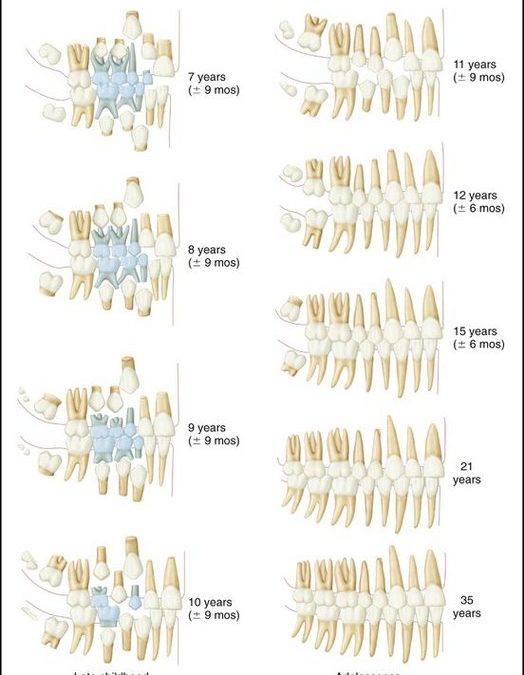
Most people think “Let’s not worry about orthodontics until all the baby teeth are gone. For most children, that’s a good time to start. For some children waiting for all of the baby teeth to fall out is too late and correcting orthodontic problems will be more complicated.
One of the most common orthodontic problems is when the canine (eye tooth) becomes impacted. Often there are no signs of an impacted canine until it is picked up too late. If it doesn’t erupt correctly it requires complex orthodontic treatment and sometimes surgery to fix. If it is identified early, orthodontic strategies such as early extraction of the baby tooth or a dental expander can help it erupt correctly. This is the pattern behind most orthodontic surprises: it’s rarely one dramatic problem. It’s a small, well-known warning sign that nobody was watching for, at the one age when it mattered.
How do I know when orthodontic treatment is needed?
Dentists are trained to assess every child for orthodontic milestones. At every check-up between ages 6 and 12, they’re really asking these questions:
- What teeth have erupted?
Are the right teeth present, in the right order, for this child’s dental age? Dental eruption and the typical ages for baby teeth to fall out and be replaced by adult teeth are well known. While there are exceptions to the rule, your child’s teeth should be benchmarked against the typical dental age.
- Are the teeth erupting in the correct order?
The order that baby teeth fall out and the adult teeth erupt is more important than the age of the child. Sometimes a child’s development is advanced or delayed compared to the average, and so the actual number of baby teeth present at any age can differ from the typical. This is fine if the sequence is correct.
- Is there enough room for the teeth to erupt?
Is there enough space in the jaw for the teeth yet to erupt? This is the single best early sign of healthy arch development. Sometimes a baby tooth falls out early or needs to be extracted early. This can lead to dental crowding as teeth drift into the space. Dental treatment may involve a space maintainer to make sure there is room left when the adult teeth need to erupt.
- Is the bite correct?
An orthodontic assessment looks at the relationship between upper and lower teeth. Is it what you’d expect at this age? There are many types of malocclusion that can be managed. Ideally the teeth of the top jaw have a minimal overjet (protrude in front of the lower teeth) and minimal overbite (vertical overlap of the lower teeth) . A normal overjet is 1.5 to 2.5 mm and a normal overbite is 1 to 2 mm.
- Are there any dental habits?
Thumb-sucking, snoring, or lip habits can quietly reshape a growing bite over time. Thumbsucking can cause an excessive overjet and bucked teeth. Snoring can cause the upper jaw to narrow and worsen dental crowding. If a child doesn’t quite meet the expected standard for their age on any of these, the dentist will have a plan – early orthodontic treatment or monitoring for a defined time before re-assessing to see if things have improved.
What are the dental milestones for my child’s age?
6 years to 8 years : the early markers.
This stretch looks chaotic in the bathroom mirror, baby teeth wobbling out, adult teeth pushing inat odd angles, but it follows a predictable pattern underneath.
Age 6: The first adult molars arrive at the back of the baby teeth, and the lower front teeth are the first baby teeth to fall out. The middle lower front incisors start coming through. A little crowding here is completely normal and nothing to worry about. What does matter: there needs to be enough space for the lower lateral incisors (the teeth next to the front two) to come through properly. If that space isn’t there, this is the point to intervene and not wait. The back teeth should meet “end to end”, which is expected at this age, and it’s worth checking for snoring, thumb-sucking, or lip habits.
Age 7: A very important age to check!. The upper central and lower lateral incisors should be in a normal position. But the most important question at this age is whether there’s enough space for the upper lateral incisors. If there isn’t, two problems tend to follow: the teeth erupt behind the bite (a palatal crossbite), and the crowding forces out the baby canine early. Losing that baby canine too soon is one of the strongest early predictors of shifting the dental midline and, later, impacting the adult canine. This orthodontic assessment at age 7 is vital.
Age 8: The best window to read growth patterns. By now the first molars should be meeting properly, and the upper and lower front teeth should be in place without crowding. An open bite (a gap between the top and bottom front teeth) can appear here and still be entirely normal. This is also the age to assess the child’s overall jaw growth pattern for how the bite will develop. Back teeth meeting “end to end” is still expected, and there should be no crossbites, front or back.
What are some common dental development problems?
Across these early years, six signs are worth flagging to a dentist rather than waiting out:
Lopsided eruption. One tooth is through, its opposite partner on the other side isn’t. Teeth should erupt in a symmetrical pattern. This may indicate that a permanent tooth is missing and warrants an Xray to check.
A baby tooth overstaying its welcome. a baby tooth that has not fallen out when it was supposed to should be removed promptly, not left to sort itself out. If the adult tooth starts to come through, it will be pushed out of position.
A tooth sinking instead of rising. This usually signals the tooth has fused to the bone underneath (ankylosis) and it will distort the jaw. It often means the adult tooth is missing.Ankylosed teeth often need to be removed to minimise jaw growth problems.
Root development that’s off. A tooth about to erupt should have roughly two-thirds of its root formed; one already through should be three-quarters developed. A tooth with a fully formed root that still hasn’t erupted won’t erupt on its own. It will likely need to be exposed and have a chain to help eruption.
Unaddressed habits. Thumb-sucking, lip habits, and snoring are never “just a phase” they’re always worth addressing. We have strategies to help correct bad habits and doing so can improve the orthodontic outcome.
A jaw relationship that doesn’t fit. Underbites, edge-to-edge front teeth, or a jaw that visibly shifts on closing all deserve assessment. Early orthodontic treatment can help.
Ages 9 to 11: the quiet years that aren’t really quiet.
Between 9 and 11, not much changes. This is the window where the permanent upper canine is quietly deciding which direction it’s going to erupt, long before it shows itself at the surface. We look and feel for a bulge in the gum above where the baby canine sits. This should reveal a firm, symmetrical bulge, the adult canine, sitting where it should, waiting its turn. By age 10 if it’s still missing, or uneven from one side, that’s no longer “wait and see”, it’s time for an X-ray (an OPG). Alongside the bulge check, a few other things matter through this phase: any gap between the front teeth (diastema) should stay under 4mm and should be closing over time, there needs to be enough room preserved for the adult canines (meaning no early loss of baby canines), and the molar bite should sit in an ideal relationship.
By age 11: the first premolars and lower canines typically erupt, the order between them doesn’t matter, space should still be sufficient for the upper canines, and the earlier gap between the front teeth should have closed.
By age 12: the full permanent dentition is typically in place, and the mouth has essentially reached its adult layout.
A quick reference
| Age | The one thing to check | If it’s missing |
| 6 | Room for lower lateral incisors | Intervene now |
| 7 | Room for upper lateral incisors | Intervene now |
| 8 | Overall growth pattern (Class I/II/III) | Assess and monitor |
| 9 | Canine bulge felt & symmetrical | Note it, recheck at
10 |
| 10 | Canine bulge felt & symmetrical | X-ray (OPG) |
| 11 | Space for upper canines, diastema closed | Monitor closely |
| 12 | Full permanent dentition |
The one habit worth building.
You don’t need to memorise every checklist item on this list, that’s what the dentist is for. What’s worth considering is the importance of regular assessment of these dental milestones t: at every dental visit between ages 6 and 12, ask “are we on track for this age?” not just “do the teeth look straight?”
Straight teeth can still be hiding a problem underneath. Caught within the right window, most of these issues have simple solutions. Caught after the window closes, they rarely do.
If anything here raises a question about your own child, call our friendly team at Jacaranda Dental and book your child in for a visit.
Glen Baker
drgbaker@me.com